
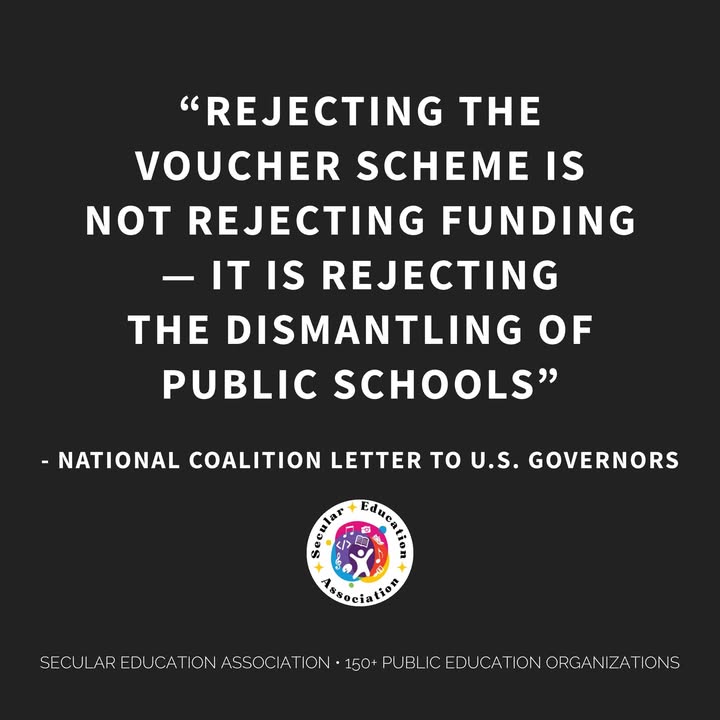
We signed onto a national coalition letter alongside more than 150 public education organizations urging governors to opt out of the federal voucher tax credit scheme.
This letter explains why voucher tax credits are not a solution to underfunded schools — and why states should reject rushed participation in a program with unresolved fiscal, legal, and civil-rights risks. Instead of strengthening public education, voucher schemes divert public dollars into private, unaccountable systems while leaving public schools to absorb the damage.
As the letter states:
“Rejecting the voucher scheme is not rejecting funding; it is rejecting the dismantling of public schools.”
Parents and taxpayers want well-resourced, fully funded public schools — not privatization dressed up as “choice.”
📄 Read the full letter here: https://docs.google.com/document/d/1G7Hoc0CDt_bF4yLzOrqs3lONinGQE6kJIgpbB-xt1y8/edit?usp=sharing
SEA opposes voucher schemes because they divert public funds into private and religious schools that are not held to the same civil-rights, transparency, and nondiscrimination standards as public schools.
Voucher programs routinely undermine the separation of church and state, weaken protections for students with disabilities, and erode accountability to families and taxpayers.
This effort was coordinated by Alliance to Reclaim Our Schools, reflecting the growing national alignment among parents, educators, and public education advocates. ❤️
What people are saying:
- Facebook User: Reject the voucher scheme!!!!
- Facebook User: You want people to buy into public schools? Have them teach basic education, (reading, writing, arithmetic), reduce the cost to the property owner, use on the best teachers, and be competitive.
- Secular Education Association: Joe Bloomfield Public schools already do teach reading, writing, and math ….and they do far more than that because real education isn’t a three-item checklist.
Public schools are legally required to serve every child: students with disabilities, English learners, gifted students, kids living in poverty, kids who need meals, transportation, counseling, and safe supervision during the school day. That’s not “bloat”, that’s public responsibility.
As for cost:
Public schools are funded by communities because an educated population benefits everyone, including property owners. In fact, strong public schools are one of the biggest drivers of property values.“Use the best teachers” sounds great but you don’t get that by:
• underfunding schools
• attacking educators
• diverting public money to private or religious programs
• or pulling students out of class during the school dayIf we want competitive schools, the evidence is clear:
✔ stable funding
✔ qualified, well-paid teachers
✔ uninterrupted instructional time
✔ accountability and transparencyPublic education isn’t a product to “sell.”
It’s a public good. Weakening it doesn’t make communities stronger, cheaper, or smarter.
- Secular Education Association: Joe Bloomfield Public schools already do teach reading, writing, and math ….and they do far more than that because real education isn’t a three-item checklist.
- Facebook User: This has got to become a national issue, not just stare by state and not just in states already deep in vouchers. We need to hit states with little involvement in vouchers so we can head off growth. Thanks for helping us get there.
- Facebook User: Facebook User Nope. Education should be a state decision. Federal meddling has not improved anything (think NCLB) and just created more bureaucracy and headaches for educators.
- Secular Education Association: Facebook User NOPE This isn’t about federal control of classrooms. It’s about federal guardrails on how public money is used.
States already run education, but voucher schemes are increasingly driven by national networks, model legislation, and coordinated funding efforts that bypass local voters and accountability. When public dollars are redirected to private and religious schools, families lose civil-rights protections, transparency, and oversight.
Protecting public education means ensuring taxpayer funds remain accountable, nondiscriminatory, and secular; regardless of which level of government is involved. That principle isn’t “meddling,” it’s basic public stewardship.
- Facebook User: yes
- Facebook User: Leave it to states. Great states will leave education to their local school boards/districts.
- Facebook User: Facebook User a lot of vulnerable children get left behind that way.
- Facebook User: Facebook User I would never ever trust the fed govt or state to provide for your family needs in school. They are just money grabbers.
- Facebook User: Facebook User I trust (or used to trust) the federal government far more than the states. The states played so many games to avoid integration in the bad, old days and will do it again in a second if given the chance.
- Facebook User: Fund public schools fully. Then if you want to fund vouchers, do that too, but taxpayers should vote on that like they do school levies.
- Facebook User: Look behind the vouchers. Somebody is collecting $$$$ for personal gain. Student welfare an afterthought.
- Facebook User: I’m sure MS knows better than other states . . .
- Facebook User: If you live in Missouri and are concerned about the defunding of our schools, please sign and support the Facebook User petition and help spread the word about it.
- Facebook User: Public education is a failure 100%. These kids don’t need one teacher per 30+ students they need an individualized education that fit them. Not all kids are alike and that is the main problem. You want the same speed with the same curriculum with the same sources with every child and if they are slower you either fail them or put them in a “special” class which then messes them up even more. Taking away the funding following children is essentially saying that you dont care for those children you only care that a lot of the money when it is getting spent appropriately (which is most of the time) is getting spent better than when public schools spend it.
- Facebook User: Facebook User Nope.
- Facebook User: Facebook User yes and its baffling that you are still on your hill🤣
- Facebook User: Facebook User Huh?
- Facebook User: Facebook User i said its baffling that one can see all the wrongs and still choose to stay wrong.
- Facebook User: Facebook User okay
- Facebook User: The big word is “unaccountable “. These private schools are not made accountable for how and where the money is used like public education. This is the problem at the federal and state level. Our public education systems, though not perfect, work hard to equally educate all students that come through their doors. They are held accountable and it is our responsibility as individual and corporate tax payers to encourage high quality public education. Privatizing education divides people and communities by location and incomes and sadly religion. This is not what our founders set up public education for.
- Facebook User: Jeanne Posgai public education is a failure 100%. These kids don’t need one teacher per 30+ students they need an individualized education that fit them. Not all kids are alike and that is the main problem. You want the same speed with the same curriculum with the same sources with every child and if they are slower you either fail them or put them in a “special” class which then messes them up even more. Taking away the funding following children is essentially saying that you dont care for those children you only care that a lot of the money when it is getting spent appropriately (which is most of the time) is getting spent better than when public schools spend it.
- Facebook User: I dont think vouchers are to blame for the dismantling of schools. I think public schools have done a great job of doing it all on their own. They just want a scapegoat instead of being retrospective.
- Facebook User: Yep!
- Facebook User: Well, we do not live in a great state!
Leave a Reply