
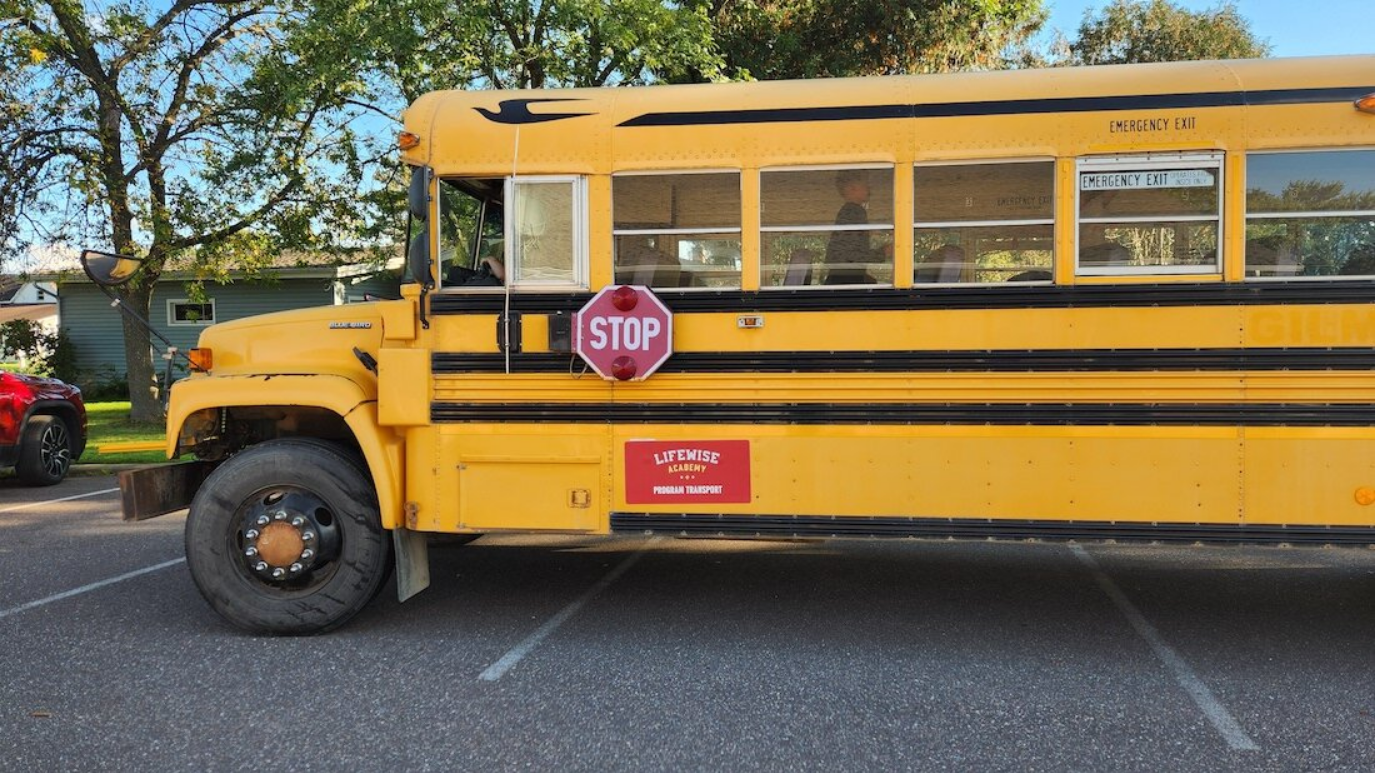
LifeWise Academy, a rapidly growing “released time” religious instruction program, sells itself to communities on a singular, absolute promise: separation. They assure parents, school boards, and skeptical taxpayers that their operations are completely distinct from the public schools they want access to. The rules are supposed to be clear-cut: the instruction happens off school property, requires explicit parental permission, runs via a private organization, and operates without a single dime of taxpayer funding.
LifeWise’s marketing campaign loves to parrot those requirements; but always conveniently leave out the part about how schools MUST remain neutral. Now, here is where the public school buses pull up.
Public records gathered by SEA blow a massive hole in that narrative. Across dozens of pages of board minutes, internal emails, and contracts, an unsettling reality has emerged: public school transportation infrastructure, including buses, district drivers, vans, fuel, and paid administrative labor, keeps showing up as part of the machinery that makes LifeWise’s operations possible.
The Fire Sale of Public Assets
When a public school liquidates heavy machinery like a school bus, taxpayers have every right to expect a transparent process that yields a fair market return to fund our cash-strapped classrooms. Instead, public records show public property changing hands for pocket change.
In Shadyside, Ohio, official board minutes from September 2023 show the school board voting to approve the disposal of Bus #18. Immediately following that vote, without missing a beat, the board approved a bid to sell that exact vehicle to LifeWise for the price of just $1.00.

A nearly identical scene played out in Indiana according to board minutes from May 2023. The superintendent and transportation director of Northern Wells Community Schools recommended selling two spare, 84-passenger transit buses to LifeWise Academy for $1 each. While administrators noted the vehicles required repairs to pass state inspections, both massive buses were explicitly documented as being in working order.

Other districts have approved sales that, while netting more than a single dollar bill, still raise serious alarms about asset valuation. The St. Clairsville-Richland City School District approved selling a 2008 International school bus to a local LifeWise leadership board for $2,800.

More recently, local reporting exposed discussions within the Holgate Local Schools district to sell two retired buses to two different LifeWise programs for a negotiated price of $4,000—a transaction that curiously lacked a clear, corresponding record in available official board agendas or meeting minutes.

These sales deserve scrutiny because even old school buses generally have value. Current used bus listings and general resale ranges show that older buses may still sell for thousands of dollars, and even non-functional buses may have scrap value based on weight and metal content. Functional 10- to 15-year-old buses often fall in the several-thousand-dollar range, while newer or well-maintained buses can sell for significantly more.
That does not automatically mean every $1 sale was unlawful. But it does mean communities deserve to know how each district determined value, whether the bus was functional, whether it was publicly advertised or bid, whether any appraisal was done, and why a private religious program received the asset at that price.
When taxpayer-funded assets are handed over to private religious programs at such steep discounts, it evades the basic principles of public accountability. A school bus does not magically stop being a public investment simply because a school board decides to liquidate it to a private religious organization for the price of a Big Gulp.
Loaning Drivers, Vans, and Administrative Hours
This goes even deeper than just the buses themselves. In several communities, the boundaries between public employment and private religious operations have completely evaporated. Public school districts are actively coordinating public personnel to act as the logistical backbone for LifeWise.
Look closely at the Wynford Local School District in Crawford County, Ohio. In November 2022, the school board approved a measure allowing any district-approved bus driver to work up to two hours per week for LifeWise Academy during the school year, categorizing it under “Personnel Items“. Exactly one year later, the board approved a similar measure, but with two glaring, quiet modifications: they doubled the driver allocation to four hours per week, and they reclassified the arrangement as an “Operational Item” rather than a personnel matter.


Internal communications reveal that public school administrators are frequently acting as unpaid logistical coordinators for these private programs:
- Plymouth-Shiloh Local Schools (OH): Internal emails show the superintendent actively calculating specific cost breakdowns for a driver to service LifeWise for 5.25 hours a day, right down to debating whether a half-hour lunch break should be deducted from their compensation. While records included a blank, unsigned contract for the arrangement, public records searches yielded no evidence that the school board ever held a public vote to approve it.

- Greenville City Schools (OH): During an April 2025 meeting, tucked oddly into the “Commendations” section of the Superintendent’s report, it was revealed that LifeWise had requested to use the school district’s own transportation vans whenever inclement weather struck.

- West Central School Corporation (IN): Across mid 2024 and early 2025, the Board of Trustees consistently utilized official sessions to systematically review and approve ongoing bus rental requests submitted by the organization, culminating in a unanimous 7-0 vote in February 2025.

Where outright asset sales or staffing hand-offs aren’t utilized, districts are crafting highly accommodating rental perks. In the case of Patrick Henry Local Schools in Hamler, Ohio, the district signed contracts with LifeWise in both 2024 and 2025. These contracts allowed LifeWise to use public school buses during an “emergency”. However, the contract defines an emergency as anytime “transportation is not available” for LifeWise. Even if that is “due to something as simple as maintenance”.
Let’s really think that through; a private group’s routine maintenance, scheduling or operational failures are magically transformed into a public school responsibility.
The Myth of “No Taxpayer Funds”

LifeWise and its many institutional allies frequently counter criticism by insisting that “no taxpayer funds” are used to support their programming. But a transparent look at public operations demands a much more specific, aggressive set of answers.
When school districts engage in these arrangements, who is truly absorbing the cost? Even if a district later seeks partial reimbursement for driver hours or vehicle use, public resources are still being expended. Public board meetings, staff email threads, contract reviews, liability exposure, route planning, and mechanical maintenance are not free simply because the beneficiary is a religious organization. A public school employee’s time is taxpayer-funded labor, and a public school garage is a taxpayer-funded facility.
When public buses are sold for single dollars, when district drivers are systematically allocated to private routes, and when public infrastructure is treated as a backup safety net, the line between church and state hasn’t just blurred- it has been completely run over, by a bus. If a released-time program cannot function without relying on the physical and administrative framework of the public school system, it is time to stop calling it separation.
It is institutional entanglement. And communities have a right to see the records for themselves.
If your local district has sold, rented, loaned, or otherwise provided public transportation resources to a released-time religious program, please contact us to share your records.
Leave a Reply