
LifeWise’s public safety messaging is built on reassurance. The organization tells parents and school boards that student safety is its priority, that adults are background checked, that staff and volunteers receive mandated reporter training, and that students are protected by “multiple adults” in the room. When concerns are raised, LifeWise’s answer is usually some version of: we take this seriously, we are transparent, and we are always working to improve.
That sounds good in a board meeting. It sounds good in a media statement. It sounds good in an FAQ. But the public record tells a different story. When a private religious organization is given access to public school children during the school day, background-check transparency should be non-negotiable. Parents should not have to search archived webpages, compare old handbooks, track media statements, and piece together deleted FAQ language just to understand who is screening the adults around their children.
But that is exactly what the Secular Education Association has had to do.
SEA was the first to publicly report the Renee Beck issue. SEA also identified and told the public that LifeWise appeared to be using Protect My Ministry for background checks before LifeWise later began publicly pointing to ProScreening. This context is an important part of understanding that LifeWise’s background-check story did not change organically, it changed after public scrutiny.
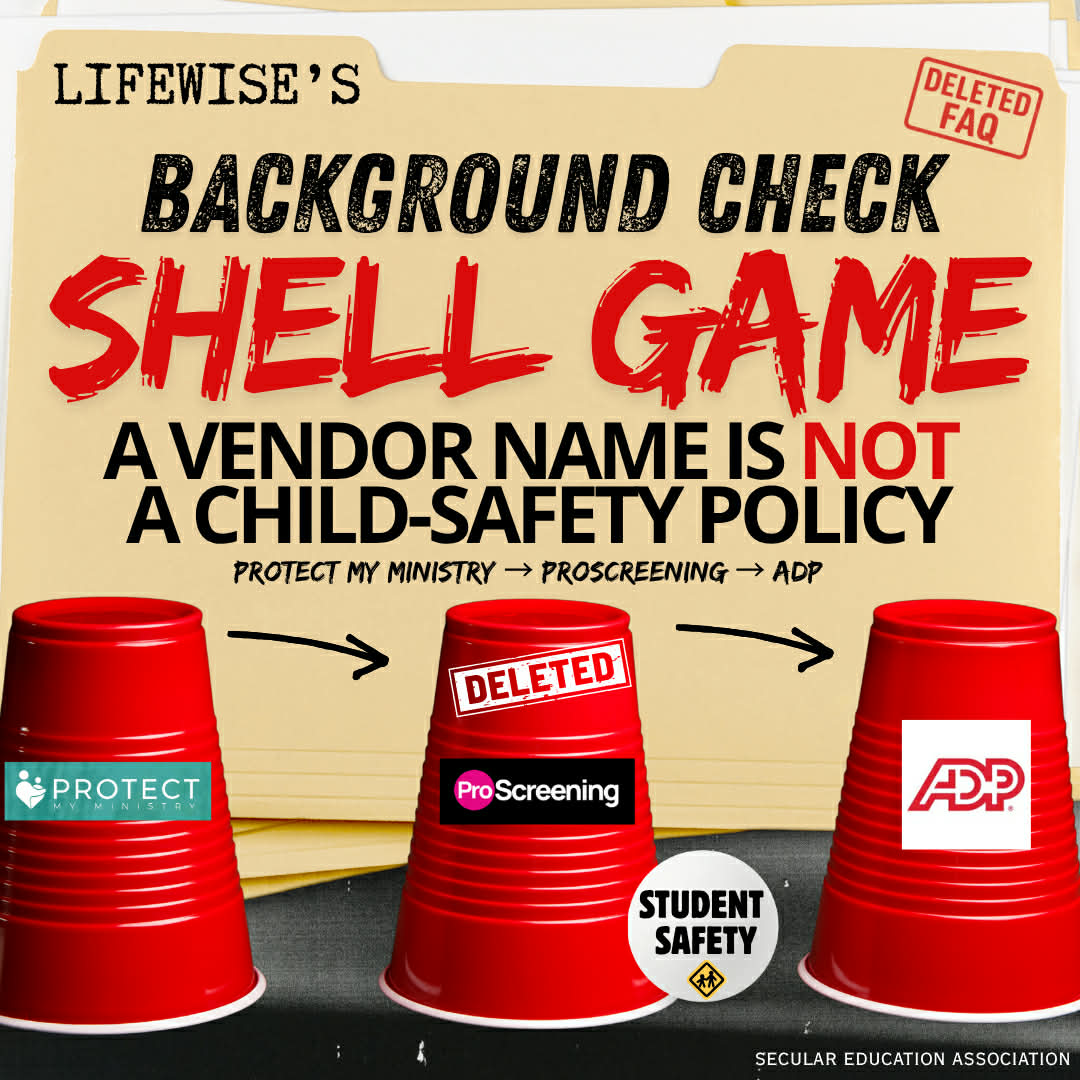
Through an ongoing review of archived webpages, LifeWise materials, and public statements, SEA found a troubling pattern: LifeWise’s background-check story changes when scrutiny hits. After serious safety concerns become public, the named vendor changes, public FAQ language gets scrubbed, and a new company name is later offered as reassurance. That doesn’t sound very reassuring, it sounds like damage control to us.
First came Protect My Ministry
The earliest background-check trail SEA reviewed pointed to a ministry-based screening system. A March 21, 2023 Wayback Machine archive showed LifeWise directing users to MinistryOpportunities.org/SFT to complete staff background checks. SEA confirmed that this platform was connected to Protect My Ministry when a SEA co-founder went through the LifeWise hiring process. This experience raised multiple red flags about the effectiveness and depth of LifeWise’s background screening procedures, which were documented in this video.
March 2024 Program Handbook and Protect My Ministry User Guide still showed Protect My Ministry as the background-check provider being used a year later.

Before LifeWise began publicly emphasizing ProScreening, its own materials pointed to Protect My Ministry, until LifeWise’s first public scandal.
Renee Beck and the appearance of ProScreening
The first major public vendor shift came in July 2024, after SEA exposed the history of Renee Beck, a local LifeWise director in Ohio whose state teaching license had previously been permanently revoked following allegations involving sexual communication with students.
After that information became public and media pressure followed, LifeWise dismissed Beck. Suddenly LifeWise’s public background-check language changed.
SEA’s documentation notes that NBC4 reporting from July 11, 2024 (when media outlets picked up the Beck story) was the first public mention SEA found of LifeWise, or anyone representing LifeWise, citing ProScreening being used for background check services according to the organization’s website. Interestingly enough, Columbus Dispatch reporting from that exact same day points to LifeWise’s website as well. However according to this reporter, the LifeWise website was showing Protect My Ministry as the service being used. Both of these reports were put together and published within 24 hours of SEA breaking the story. The LifeWise website changing fast enough to cause conflicting reporting in such a narrow time frame certainly gives the appearance that this change happened quite literally mid-scandal.


The WayBack archive confirms this timeline as well, showing that sometime between July 5 and July 15, 2024, LifeWise updated its public FAQ to say employees and volunteers underwent “a comprehensive background screening conducted by ProScreening.” The updated FAQ said all LifeWise staff, Leadership Board members, and volunteers were screened through ProScreening upon hire and every three years. It also said Program Directors, Leadership Board members, teachers, drivers, and volunteers completed Child Abuse Awareness and Mandated Reporting training on that same schedule.

So after a major vetting failure became public, LifeWise suddenly changed from a vendor who’s name flagrantly displayed the priority of protecting LifeWise as a ministry, to a vendor with a name that would reassure parents and school boards that their “screening” was “professional”. But a vendor name change does not equate to our public school-level safety standards.
Christopher Riggs and ADP enter the timeline
Just a little more than a year later, the background-check story shifted again.
Public reporting from TiffinOhio.net states that Christopher Riggs, a former LifeWise teacher with the Tri-Valley chapter, resigned from LifeWise in November 2025. November is also coincidentally when the most recent crime occurred. Riggs later pleaded guilty to voyeurism and gross sexual imposition involving a minor. The same reporting states that LifeWise said all three former affiliates in the reported Ohio cases had passed the organization’s background checks and that law enforcement had not alleged the misconduct occurred during LifeWise programming.

Soon after that resignation window, LifeWise’s hiring system changed yet again. Wayback Machine archives show that sometime between November 21, 2025 and January 6, 2026, LifeWise’s careers page stopped redirecting applicants to lifewisesupport.isolvedhire.com/jobs and began sending them to an ADP-hosted LifeWise careers page.

A careers-page redirect does not prove the exact date LifeWise changed background-check vendors. But the timing raises obvious questions. Riggs resigned in November 2025. The next archived window shows LifeWise’s hiring system shifting toward ADP. By May 2026, LifeWise was telling reporters that all staff and volunteers were screened through ADP Screening and Selection Services. That is the point. When serious questions hit, LifeWise’s background-check story changes.
ProScreening disappears from the LifeWise FAQ
Between March 8 and May 3, 2026, archived versions of LifeWise’s website show that LifeWise removed public references to ProScreening from its background-check language.
During that window, LifeWise made two major edits. First, it deleted an entire FAQ question under the “Operations” section titled, “What type of background screening is conducted?” That deleted answer had specifically named ProScreening.
Second, LifeWise modified another FAQ answer titled, “Are LifeWise teachers and volunteers background-checked? How do you keep kids safe?” In that edit, LifeWise removed references to ProScreening and did not name a replacement vendor.
The old language described ProScreening as a consumer reporting agency and a member of the Professional Background Screening Association. It also said ProScreening was recognized and used by “thousands of businesses and ministries across the country.” The newer language kept the broad claim that LifeWise volunteers, staff, leadership, and board members undergo background screenings, but replaced the specific vendor language with vague wording about “nonprofit industry standards.”

That is not more transparency. It is less. When ProScreening was useful for public reassurance, LifeWise named it. When the story got messier, ProScreening vanished from the FAQ.
Three former affiliates, one new public answer
By May and June 2026, the public learned that three former Ohio LifeWise affiliates had been charged with or pleaded guilty to sex crimes involving minors: Christopher Riggs, Kenneth Holycross III, and William VanSickle. TiffinOhio.net reported that the three cases were unrelated, that law enforcement had not alleged the misconduct occurred during LifeWise programming, and that LifeWise said all three men had passed its background checks.
WVXU later reported that two former employees and one volunteer at LifeWise had either been arrested or pleaded guilty to sex crimes against children, and that a volunteer group of parents uncovered the connection between the three suspects and LifeWise. WVXU also published LifeWise’s statement saying all staff and volunteers undergo background screenings through ADP Screening and Selection Services before serving. That became the new public answer: ADP.
But the problem was never just the name of the vendor. The problem is that LifeWise keeps using background checks as a shield while the public is left trying to figure out what those checks actually include, who they cover, whether they match public school standards, and whether existing adults are re-screened when LifeWise changes systems.
Private vendors do not equal public school safety standards
There is a bigger problem than LifeWise changing from Protect My Ministry to ProScreening to ADP. None of those private vendor names prove LifeWise is meeting the same standard required of public school employees.
A private consumer-reporting background check is not automatically the same thing as a fingerprint-based, state-regulated school background check. Public school systems are often required to use state and federal criminal-history checks, fingerprinting, child-abuse clearances, disqualifying-offense rules, or ongoing reporting systems. That is a very different level of public oversight than a private organization saying, “We use ADP,” “We used ProScreening,” or “We conduct background checks.”
This matters nationally because LifeWise is not operating in one district or one state. TiffinOhio.net reported that LifeWise’s most recent IRS filing showed roughly 60,000 students in 32 states. If LifeWise is asking public schools across the country to release children into its care during the school day, every school board should be asking whether LifeWise adults are screened to the same standard required for adults working inside public schools in that state.
Florida law, for example, requires instructional and noninstructional personnel hired or contracted for positions requiring direct student contact to undergo required background screening, and bars certain ineligible individuals from serving in roles requiring direct student contact. Pennsylvania school law requires applicants for public and private school employment, independent-contractor employees seeking business with schools, and student teacher candidates with direct student contact to undergo background checks, including child-abuse history clearance, state police criminal records checks, and federal criminal-history checks. Pennsylvania also requires background checks for certain school volunteers with direct contact with children.
That is the standard districts should be comparing LifeWise against. Not “Which vendor are you using this year?” Not “Did you say you run checks?” The question is whether every LifeWise adult is being screened at least as thoroughly as the adults inside the public schools those children are leaving.
FastFingerprint fingerprinting?
LifeWise’s own FastFingerprints billing form shows that the organization has a pathway for fingerprint-based checks. But the materials SEA reviewed do not present fingerprinting as the clear baseline for every adult in every LifeWise program.
In the screenshots reviewed by SEA, the form asks users to select a state, and the only visible options are Ohio and Florida.

The Ohio language says LifeWise programs “may desire” to have board members, staff members, and/or volunteers complete a BCI or FBI background check involving fingerprints. The Florida language uses similar wording for Level 2 fingerprint background checks.


That wording matters. If fingerprinting were the universal safety standard for LifeWise adults, the language would not read like an optional state-specific pathway. It would say every adult in every program must complete it.
The form also separates fingerprint-based checks from the ADP background check LifeWise describes as part of its standard onboarding process. So when LifeWise says staff and volunteers go through ADP, that does not automatically mean every adult has completed a fingerprint-based BCI, FBI, Level 2, or state-regulated school-style background check.
That leaves school boards with an obvious question: if LifeWise already has a fingerprinting framework available, why is it not required for every adult around children? Is it because of cost, convenience, administrative burden, or because LifeWise only adds fingerprinting where state law or local pressure requires it?
Whatever the answer, “we do background checks” is not enough. Districts should require LifeWise to state clearly whether every teacher, volunteer, driver, substitute, Program Director, and Leadership Board member is fingerprinted and screened to the same standard required for adults working inside public schools.
What school boards should ask
School districts should not stop at asking which vendor LifeWise uses. They should require written answers to the questions that actually matter.
What exact screening package is ordered? Are checks fingerprint-based where public schools require fingerprints? Are state and federal records searched? Are county-level records included? Are child-abuse registries checked where applicable? Are drivers subject to motor vehicle checks? Are volunteers screened the same way as employees? Are Program Directors and Leadership Board members screened? How often are checks renewed? Who verifies completion? What offenses disqualify someone? Were existing adults re-screened when LifeWise moved from one system to another?
These are not anti-religion questions. They are basic child-safety questions.
Passing a LifeWise background check does not automatically mean passing the same screening required of a public school teacher, school employee, or covered contractor. A rotating private vendor name is not a child-safety policy.
If LifeWise wants access to public school children during the school day, districts should stop accepting public relations answers and start requiring proof: proof of what was checked, who was checked, how often checks are renewed, what disqualifies someone, whether drivers and volunteers are included, whether existing adults are re-screened when systems change, and whether LifeWise’s private process meets or exceeds the public school standard in that state.
“We do background checks” is not enough.
Leave a Reply