
December 2024 — A Settlement Agreement Is Reached
In the summer of 2024, LifeWise Academy filed a copyright infringement lawsuit against Secular Education Association co-founder Zachary Parrish in federal court over Parrish’s publication of the LifeWise curriculum. After months of negotiations, both parties signed a mutually accepted settlement agreement in December 2024. As part of the settlement, Parrish agreed to remove and stop distributing complete copies of the curriculum. In exchange, LifeWise agreed to provide at least 48 hours of review access—with no limit on how many times a person may request it—to the “complete, current LifeWise Curriculum, including any updates thereto.” The agreement explicitly defines the “LifeWise Curriculum” as the complete set of materials, for all age groups, disseminated to students enrolled in LifeWise programs.

June 2025 – The First Formal Demand For Compliance
Six months after the settlement was signed, LifeWise’s curriculum-review system still did not provide access to its complete middle-school or high-school curriculum. Instead, reviewers were directed to outside websites where some of the materials could be purchased. On June 9, 2025, Parrish’s attorney sent LifeWise a formal letter alleging that this violated the settlement agreement and warning that court intervention could follow if LifeWise did not comply.
The letter reiterated that the agreement does not distinguish “between materials created by LifeWise and those created by others” and “unambiguously requires LifeWise to make all materials disseminated to students available.” Parrish’s attorney further explained that the agreement recognizes that LifeWise may use materials made and owned by other parties, but still requires those materials to be fully accessible for review.

Before the end of 2025, however, SEA found evidence raising new questions about whether LifeWise’s review system actually included all materials “disseminated to students enrolled in LifeWise programs.” Those questions came directly from LifeWise’s own descriptions of its high-school course options.
High School Course Options
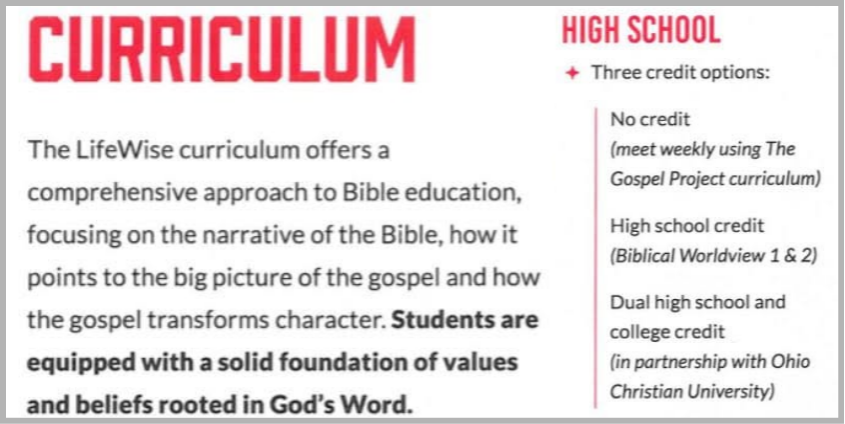
In response to the first compliance demand, LifeWise’s attorney said the curriculum list had been updated in the review-access document and claimed that “all the curriculum which is currently used is linked.” LifeWise’s own promotional materials, however, advertised three distinct high-school paths: a no-credit option, an option through which students could earn elective high-school credit, and a dual-credit option through which students could earn both high-school and college credit.
The “Curriculum” section of the “Why LifeWise? Resource Guide,” distributed to school administrators, identified different materials or providers for those options. It described the no-credit option as using The Gospel Project, the high-school-credit option as using Biblical Worldview 1 and 2, and the dual-credit option as being offered through a partnership with Ohio Christian University. The guide did not identify the curriculum used for the dual-credit course. LifeWise’s own materials therefore raised a straightforward question: If all curriculum currently in use was linked for review, where were the materials for each of these separately advertised options?

Despite LifeWise’s claim that all curriculum currently in use was linked and available, its review system provided only one high-school file, labeled “High School Combined Lessons.” The document contained the materials LifeWise identified with its high-school-credit Biblical Worldview course; it did not separately identify materials for the no-credit Gospel Project option or the dual-credit option offered through Ohio Christian University.

The single high-school file labeled “HS Combined Lessons” opened to a curriculum titled “Introduction to Biblical Worldview.” Its acknowledgment page identifies the curriculum as “a derivative of Foundations, Book I in the Understanding the Times Series from Summit Ministries”.

The curriculum provided for review was therefore not The Gospel Project, which is published by Lifeway Christian Resources. LifeWise’s own resource guide identified The Gospel Project and Biblical Worldview as materials for separate high-school options, yet the review system provided only the Summit Ministries-derived “Introduction to Biblical Worldview” document. At that point, the review materials did not identify which Gospel Project curriculum was being used for the no-credit option or what curriculum students received through the dual-credit course offered in partnership with Ohio Christian University.
December 2025 — A Second Request For Answers
After SEA obtained LifeWise’s promotional guide through a public-records request and identified the three separately advertised high-school options, Parrish asked his attorney to contact LifeWise again. His attorney noted that “Introduction to Biblical Worldview” was the only high-school curriculum available for review, asked whether the materials for the other advertised options would be made available, and requested an explanation for the apparent discrepancy.

LifeWise’s attorney responded that the no-credit option referred to LifeWise’s middle-school Gospel Project curriculum. He also said he believed the 137-page “Introduction to Biblical Worldview” document was the complete high-school-credit curriculum and included what LifeWise called Biblical Worldview 1 and 2, although he said he would confirm that with his client. The response therefore addressed two of the three advertised options—not just one—but did not explain the dual-credit course offered through Ohio Christian University.
Parrish’s attorney followed up, asking how one curriculum accounted for the multiple credit-bearing pathways and programming across four high-school grade levels, whether The Gospel Project and the Summit Ministries-derived curriculum were entirely separate bodies of work, and what accounted for the college-level dual-enrollment option. The correspondence provided shows no further response to those questions at that time. While the claim that LIfeWise’s no-credit high school courses were simply using the same Gospel Project curriculum designated for their middle school courses is nonsensical, what stood out even more was the fact that the curriculum used for the advertised dual-credit option just remained completely unacknowledged and unexplained.
July 2026 — A Third Formal Demand For Compliance
In spring 2026, SEA found LifeWise materials promoting a newly launched Summer Camp/Vacation Bible School program with its own curriculum. Those materials were not included in LifeWise’s curriculum-review system, raising another question about whether LifeWise was providing access to every set of materials covered by the settlement agreement. So with the questions surrounding the high-school options still unresolved and additional summer materials now identified, Parrish sought assistance from his attorneys at the Electronic Frontier Foundation.
On July 27, 2026, EFF sent LifeWise a third demand, alleging that LifeWise still had not provided access to all materials covered by the settlement. The letter acknowledged that “Introduction to Biblical Worldview” and LifeWise’s middle-school curriculum had been made available. Although failing to address the discrepancy of the non-credit high school course advertised as using curriculum from The Gospel Project and no such materials being provided, EFF did specifically request access be provided to two additional sets of materials: the curriculum for Christianity, Culture, and Worldview and LifeWise’s Summer Camp/Vacation Bible School curriculum.

LifeWise’s Response
In response, LifeWise’s attorney argued that the summer-camp curriculum falls outside the settlement because, in LifeWise’s interpretation, the term “LifeWise programs” refers exclusively to its released-time religious instruction programs. The settlement agreement does not expressly define “LifeWise programs” that narrowly. Parrish therefore disputes LifeWise’s interpretation and maintains that the term reasonably includes any and all programs designed and offered by LifeWise. Parrish maintains that if LifeWise wanted a narrow and specific definition of “LifeWise programs”, they should have included language that defined the term while negotiating the settlement agreement.

Regarding Christianity, Culture, and Worldview, LifeWise’s attorney responded on August 12, 2026, that the course “is not a LifeWise Academy course” and is not part of the LifeWise Curriculum. According to LifeWise, the asynchronous dual-credit course is offered, developed, owned and delivered entirely by Ohio Christian University. Students enroll directly with OCU and receive OCU credit, while LifeWise says it does not own, license, access or share the course curriculum. LifeWise described it as a pilot in which students from a single LifeWise program had enrolled.

LifeWise’s attorney also said they cannot produce copyrighted material that they neither own nor possess, choosing instead to direct reviewers to OCU’s publicly available course information, which is nothing more than a paragraph long description from an OCU course catalog.
This argument was the basis of their refusal to share any curriculum to begin with, and was previously addressed by Parrish’s attorney in his first compliance letter.

That is LifeWise’s defense. But the real question is simple: does that defense match what LifeWise itself has actually done? Because LifeWise advertised the course, organized access to it, restricted enrollment to LifeWise students, and paid for it.
Christianity, Culture, and Worldview Course
This “pilot” program can be traced back at least 5 years. Reporting from 2021 by the Van Wert Independent announced the partnership between OCU and LifeWise by describing how LifeWise would be “offering” the course. The article states that students can enroll in the class at LifeWise Van Wert and instructs students interested in enrolling to register through LifeWise’s website.

A 2023 Richland Source report added another layer: it stated that older LifeWise students could take the online college-credit course through Ohio Christian University and that LifeWise covered the cost of this course for their students.

But perhaps the most damning piece of evidence against LifeWise’s claims that Christianity, Culture, and Worldview “is not a LifeWise Academy course” and “is not part of the LifeWise Curriculum“ comes from their own Program Handbook. The 2024 edition of LifeWise’s Program Handbook explicitly lists Christianity, Culture and Worldview as one of the high school courses offered by LifeWise under the Curriculum section. But the part that really stands out is this statement – “All LifeWise students are a part of LifeWise-only sections of the course”.

Taken together, LifeWise’s handbook, its student-registration process, the LifeWise-only course sections and the reported payment of tuition show that LifeWise did far more than merely point students toward an unrelated third-party course.
How can the claim hold that this is not a LifeWise Academy course when the college has separated the course into LifeWise exclusive sections so that LifeWise may offer the course while paying for it and even listing it as part of their high school courses and overall curriculum. How is it not a LifeWise program when LifeWise students take this course during the LifeWise period of their school day and are only able to enroll in this class through LifeWise, after registering for the LifeWise program on their website?
After further correspondence between EFF and LifeWise’s attorney, LifeWise decided instead of meeting their obligations, they would simply stop promoting Christianity, Culture, and Worldview as a LifeWise program. They did not claim they would stop offering it, or that LifeWise students would no longer be taking it, only that they would stop promoting it as one of their programs.

At some point, the denial and dodging becomes absurd. LifeWise recruits the students, controls access, places them in LifeWise-exclusive sections, schedules the course during the LifeWise period, pays the tuition and claims it as part of its own curriculum. If LifeWise controls every doorway into the classroom, it does not get to pretend the course belongs to someone else when accountability comes knocking. They should not be allowed to skirt their obligations because they don’t own the curriculum materials. They cannot set their own definition of what constitutes a “LifeWise program”. Most importantly, they cannot simply disregard the agreed upon terms which state they must make available the complete set of materials, for all age groups, disseminated to students enrolled in LifeWise programs.
If LifeWise Academy cannot follow the terms of a legal agreement they voluntarily entered, how can parents be expected to trust them when it comes to anything else?
If LifeWise cares about transparency as much as they constantly claim they do, why would they not simply provide these materials for parents to review on their own accord?
Why is a single parent continually being made to force legal compliance of a multi-million dollar religious organization?
Why is there no accountability, recourse, punishment or remedy when LifeWise has failed to comply with their legal obligations time and time again?
*Curriculum materials shown are used with permission and copyright protected.
Leave a Reply